af Burg Think Tank
Burger Hof Think Tank
By
Hansjörg (Johann Georg) Rogger
“Drive straight ahead, then make a sharp right turn.” The navigation system’s final instruction: “You have reached your destination.” It’s another 200 meters to the Burger Hof—the place where people say that learning must work differently than it still seems to in schools.
I’ve been invited to the “Ideenschmiede”—a place where the school system is once again being put to the test. Here, ideas are refined, questioned, and put to the test. I want to see firsthand which challenges are being addressed and what ideas are emerging.
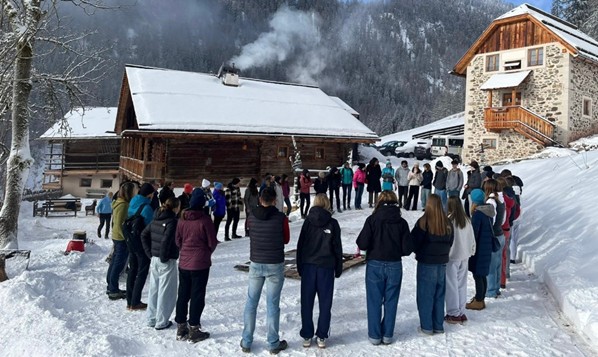
A bright, sunny winter day at an altitude of 1,400 meters. An idyllic mountain farm, a steep, sun-drenched slope, sweeping meadows below, and high up on the steep slope, the beginning of a spruce forest. Here I meet a well-coordinated, dedicated team that passionately cares for students of all ages.
Nearly ten years have passed since it all began—since the Burger Hof was established as a place of learning. It all started with a donation, accompanied by a clear goal: to promote the well-being of children and young people in the Puster Valley.
“The fact that the EOS social cooperative is contributing this donation to the ‘Kooperation Pustertal’ network and placing the farm’s development in the hands of all those who work with children and young people in the Puster Valley breaks with tradition,” wrote one of the key promoters, Josef Watschinger, in 2016.
And now I’m standing in this very spot, which Josef Watschinger—long before the donation—had “tucked away in his index card box as a dream.” That’s how he put it back then.
From the very first impression, I sense that school and learning take place differently here—in a place that doesn’t look like a school at all. Originally, farmers lived here, struggling to make a living at an altitude of 1,400 meters. “Opportunities were limited; people were preoccupied with ensuring their own survival and that of their families.” (Heiner Nicolussi-Leck, EOS Social Cooperative)
Today, it’s a place of learning. The “Ideenschmiede” is taking place here for a week—a special experience for 26 students.
The “Idea Lab” is intended to be a space where students can freely express what they want for their school. Their thoughts and feelings are expressed through sketches, drawings, sculptures, and painted emotions.
“The affects … are the root of emotional life, of the power of the soul” (Nicolai Hartmann, 1949).
The goal is therefore clear: to incorporate emotions and take emotional experiences into account in order to give weight to emotional strength. Without emotional strength, little to nothing works. It shapes our thinking, our actions, and our interpersonal relationships—at school and beyond. Emotions influence motivation, learning behavior, and social interaction.
Before I find out what the young people have to say, I run into Alex, the school projects coordinator—the heart and soul of the Burger Hof project. In the hallway of the farm building, I do what everyone else does: I take off my shoes.
Alex brings me the cappuccino and asks Gerd Innerebner, the operations manager and an EOS employee, to show me the farm building and the house. I put my shoes back on and walk into the barn to see the sheep. The smell of hay and animals envelops me as I walk along the sheep pens and listen intently to how the fifteen sheep here at the Burger Hof are cared for. Gerd opens the door, and the sheep, accompanied by their little lambs, stream out into the snow. Soon two donkeys will join them and, naturally, chickens with their own coop.
Back to the young people. At eight stations, they’re presenting their ideas, wishes, and visions: What might a different kind of school look like? What challenges do they face? What’s weighing on them? They’ve been grappling with these questions for a week. For decades, people have been thinking about what school could look like differently—now I’m eager to hear their answers.
A signal bell rings. I look around. Everyone gathers in a circle. Alex raises his palm, and the side conversations die down—everyone here knows what to do. An astonishing sense of order in the midst of a creative atmosphere.
Relationships, learning environments, tranquility and well-being, nature, diversity in the classroom, innovation, independence, and competent teachers—these are the eight topics that were addressed. They will now be presented.
Solutions from the students’ perspective: Fostering a culture of paying attention rather than looking away—fostering a respectful, open, and transparent classroom environment—accepting criticism and welcoming new ideas—dialogue on equal terms.
Only once this foundation has been laid can education be more than just the transmission of knowledge and—crucially—can it enhance the quality of that knowledge. That is why relationships are not a side issue, but rather the foundation for successful learning, the group spokesperson summarizes.
Alongside the posters, the young people lay out their visual creations—sketches, drawings, and sculptures—on the floor, making their thoughts and ideas not only audible but also visible. This is the final stop where they share their work with us. Some messages are enigmatic and multi-layered; others are direct and blunt. Every image, every sculpture tells a story: of hopes and fears, of desires and doubts, of anger and a thirst for revenge. A quiet but powerful dialogue—sometimes accusatory, sometimes demanding. It compels us to look more closely and not to overlook the nuances.
“Words are just smoke and mirrors…,” wrote Goethe—an observation that takes on a deeper meaning in the world of school than it might seem at first glance. For what truly moves children and young people often remains unspoken. Their thoughts, fears, and hopes are hidden behind polite answers, evasive glances, or the quiet silence that is sometimes louder in the classroom than any debate. But where words fail, images find a way.
Drawings, sketches, and paintings reveal more about the students’ inner experiences than words ever could. A sketch featuring a coffin, a noose, and a clock—what does it convey? Is it anger? Despair? A silent cry for help? Through shapes, colors, and stylized elements, young people lay bare their innermost thoughts, often without even realizing it. Their images are statements—raw and unadulterated—and that is precisely where their power lies.
This visual language is crucial when it comes to reflecting on relationships and structures. How do students experience the school system? How do they perceive their interactions with one another? What role do teachers play in their daily lives—as supporters or as insurmountable obstacles? A single image can tell a whole story, revealing an unspoken truth that would otherwise be lost between the lines.
It’s up to us to look closely. Not just at what’s obvious, but at what’s hidden in the shadows, lines, and nuances of color. Because when we let images speak for themselves, we may be listening for the first time.
With that thought in mind, I leave the Burger Hof and reflect on my impressions as I drive down the mountain.
Amid all the debates about educational reforms, digital innovations, and new teaching methods, what really matters is often overlooked: the relationship between teachers and students. I realize that a central theme runs through this discourse—without a constructive, respectful relationship, learning is not very effective.
All educational concepts—whether they involve progressive educational approaches, technology-enhanced learning, or methodological innovations—can only reach their full potential if the foundation is right: mutual trust, respect, and a genuine interest in the students’ development. No matter how competent a teacher may be, if the personal connection is missing, the knowledge remains abstract and difficult to grasp.
Education is more than just the transmission of information. It is a shared process in which young people not only acquire knowledge but also learn to understand themselves and the world. This requires educators who not only teach but also listen, observe, and create an environment in which students feel taken seriously.
Everything else—technological advances, modern teaching methods, or financial resources—takes a back seat to this relationship. After all, it is not the equipment in a classroom that ultimately determines learning success, but the quality of the human interaction that takes place there.